



Ebike Industry Updates
Velotric has managed to deliver a solid trekking bike at a $1,999 MSRP. Its powerful motor makes efficient use of the 710Wh battery (tested in torque-sensing mode, which helps), and it’s equipped with solid Kenda 27.5×2.6” MTB tires that provide good traction, stability, and respectable cornering on loose surfaces.
The 8-speed Shimano drivetrain performs reliably, offering suitable gearing for both fast-paced flats and easier uphill climbs. A slightly broader gear range would have been welcome for hitting Class 3 top speeds more comfortably, but with a quickened cadence, it gets the job done.
The bike features a coil suspension fork with 120mm of travel. The UD34 Boost fork isn’t a household name in the industry, and while it’s fine for lighter applications like trekking and smoothing out rough, cracked roads, it’s not designed for jumping or overly aggressive use in the dirt. The suspension leans on the firmer side but performs fine for its intended purpose.
The key touchpoints—grips, saddle, and pedals—are all nice, offering comfort and functionality.
The Summit’s commuting aspects may require some upgrades unless you just use a backpack. Velotric doesn’t include a rack or fenders, though these are available as optional accessories. You can also upgrade to a suspension seatpost for added comfort or attach bags for carrying supplies.
Electric bikes have rapidly gained popularity over the past few years, and it turns out they are a great way to explore Edinburgh. Edinburgh was built on an extinct volcano, so it has many hills, and it can require some effort to get around on a bike. This is why e-bikes have become increasingly popular in Edinburgh as they take the effort out of cycling, especially up those hills. This, along with all the many miles of e-bike paths and disused railway lines around the city centre and the surrounding area, makes e-biking a great choice to enjoy Edinburgh, with many incredible sights to see and places to visit.
Many citizens are choosing electric bikes for commuting and travelling around the city, as often it is quicker to cycle across the city rather than drive or take public transport. When you add the assistance an electric bike gives, you also get to work or your destination fresher and less sweaty.
Edinburgh would be a great choice for your next e-biking adventure due to the stunning views of the historic city and all the green spaces throughout the city centre and beyond. Because of all of these cycling routes around the city, Edinburgh is very cycling-friendly, so it is an amazing place to cycle around, have lunch, and enjoy the city and the views.
If you are looking for longer rides, there are beautiful areas outside Edinburgh, including the iconic Forth Bridges and Queensferry Crossing to the West or into the majestic Pentland Hills.
Before you set out on your e-bike journey around Edinburgh, there are certain actions you can take to maximize your enjoyment of the city. Firstly, make sure your route will take in all the sights you wish to see on your day out. Sites such as Edinburgh Castle, Calton Hill, the Scottish Parliament building, The Meadows, and many more. Once you have the sights you wish to see, you can set about planning your perfect route, whether on cycling routes or quiet roads.

The topic of Ride Quality is more subjective than our other test sections, but we will try to paint a picture of what it is like to ride the Mokwheel Granite. This section will cover elements such as sizing/fit, motor engagement, the user interface, comfort and suspension, handling, etc.
The Granite is recommended for riders from 5’0” to 6’2”. At 5’11”, I felt this to be generally appropriate; I had both the handlebar and saddle height maxed out during my testing. With 4.5” of adjustment in the former, I found it comfortable with the trike’s upright riding position, though I was not able to reach full leg extension with the 6” range in the seatpost.
Usually, this would be cause for concern, but we do not consider it a problem on an e-trike with a cadence sensor. The Granite does not require active pedaling, so maximum efficiency is not essential; its ride is instead relaxed and low-effort (if the rider chooses to pedal at all). Those seeking an effort-free experience can simply use the throttle.
In fact, pedaling the Granite was somewhat tough due to its large (but quite comfortable) saddle and non-adjustable backrest. The shape of the saddle impeded the motion of my legs when sitting fully against the backrest; I had to perch on the edge to be able to pedal. We’d prefer the backrest to be adjustable forward-backward for more comfortable pedaling.
Generally, the ride was comfortable due to the aforementioned saddle, ergonomic grips (faux leather with gel support), and the trike’s suspension. The Granite features a suspension fork with 80mm of travel to reduce the impact of bumps on the handlebars. Ours also included a suspension seatpost (an optional but recommended accessory).
Regardless of how many wheels it has, the ANYterrain Stabilized 4-wheel Electric Bike is a relatively unique offering from Sixthreezero. We believe it could open up a world of potential for those who need even more stability than what is granted from the two wheels of an e-bike or even the three of an electric tricycle.
We have seen a handful of other brands making similar four-wheeled e-mobility devices, but these are typically recumbent designs with low, reclined seating positions. The ANYterrain’s upright position is more akin to a traditional bicycle or tricycle, though it raises the vehicle’s center of gravity, which could potentially make it feel somewhat tippy (although it was definitely hauling tail in the brand’s launch video!).
We are highly intrigued by the quadricycle’s tilting wheels, which aim to increase its stability; Sixthreezero’s tadpole trike (two wheels in the front and one in the rear) uses a similar design. Logically, the system makes more sense with a single rear wheel than two, though we expect the ANYterrain’s overall weight helps to keep it firmly on the ground.
Due to its overall weight, however, its portability may be hampered. Many e-trikes, including Sixthreezero’s EasyTransit Folding Electric Tricycle, employ folding frames to make them easier to transport. While the ANYterrain’s battery can be removed to make it lighter, its footprint and total weight will likely make transport difficult without a ramp.
Another intriguing feature of the ANYterrain Stabilized quadricycle is its 750W motor, which uses a mounting design pioneered by Lectric in its XP Trike. Based on our experiences with that tricycle—and a couple of others that borrowed the idea—we expect Sixthreezero’s “e-quad” to have a natural pedal feel similar to that of a mid-drive motor.
One of Hollywood Racks nicest products to date is one of the smoother operating racks they’ve produced, but still undercuts most of the competition.
Hollywood Racks has long been one of the go-to options for a quality bang-for-your-buck hitch rack. The products are true workhorses; they aren’t the fanciest options on the market, but they’re routinely a few hundred dollars less than comparable models while going toe-to-toe on most features and occasionally going beyond.
Spending less for similar features sounds great, but there is usually a caveat or two to consider. Competitors were typically a little more sleek, and while it could carry bikes of similar sizes, the adjustments when fitting bikes were often clunky. Consider those problems addressed with their latest model, the Crosstrack, all while keeping the ethos of producing a product that undercuts others on the market.
The Crosstrack is a platform-style bike hitch rack that uses two arms to establish contact with the tires. The rack handles bikes up to 66 lbs and fits most tires from 20-29” in diameter and up to 4” wide with a 52” long wheelbase.
With no frame contact and an easy-to-fit tray system, the Crosstrack can be loaded up in seconds, and it works nicely for different styles of e-bikes, from road and gravel to eMTB and city. The front-handle pull system quickly snaps the rack into one of four positions, and once I figured out the best practice for unloading bikes, it was a simple start-to-finish experience getting bikes from the garage to the the trailhead and back again.
This has been an intensive year for me in hitch rack product testing and as is often the case, the drawbacks I could find on the Crosstrack for hyper-specific to the life of a bike tester or somebody who is swapping between bikes with different tire-sizes frequently, but overall, I was highly impressed with the Hollywood Racks Crosstrack after weeks of testing and reviewing it. For all the details, read on!
Some links may be affiliate links. We may get paid if you buy something or take an action after clicking one of these.
Rather than try to improve upon presta or Schrader valves, Schwalbe designed a whole new valve and pump head that is easy to operate and airtight.
German tire maker Schwalbe has introduced a new valve for bike tires. Schwalbe’s Clik Valve (SCV) aims to make valves simpler, more foolproof as well as improve the interface between the valve and the pump head.
The Clik Valve is the same diameter as a presta valve, but it requires a new pump head. The pump head snaps onto the valve with little pressure—Schwalbe says just two fingers are enough—and in snapping closed, it creates an air-tight seal.
The primary market for the Clik Valve will be cyclists running tubeless tires, in part because the valves allow a 50 percent greater airflow through the valve than with traditional presta valves.
For those using presta valves with inserts, it is possible to replace the insert alone, rather than replacing the entire valve, which would necessitate removing the tire.
Tern offers the D9 in a single frame size intended for riders between 5’1” and 6’1”. The bike includes a long seatpost and a telescoping stem with approximately 9.5” of saddle height and 4.5” of handlebar height adjustment to customize its fit. At 5’11”, I had both points of adjustment set near their maximum, so the advertised height range made sense.
I found the bike generally comfortable; its ergonomic handlebars and rubber grips were easy to hold for long rides. Its saddle was on the slim/firm side, though that was not unexpected considering the bike’s commuter/city bike influence.
The Quick Haul Long’s riding position is forward-leaning (slight to moderate, depending on the handlebar height) with a bottom bracket that felt somewhat shifted forward, so pedaling seemed to require more outward force instead of downward pressure. I found that this took some getting used to, but the adjustment period was short.
As mentioned previously, the bike felt relatively light and nimble for its size; its wide 700 mm handlebars offered controlled steering and its small wheels felt quick to turn.
In terms of features and the user interface, the Quick Haul Long took a minimalist approach. Its small display/control panel occupied the left handlebar while the right hosted the Tektro trigger shifter and a small bell. The bike includes lights and fenders, but no other bells or whistles; this helps to keep its cost relatively low in comparison to other Tern models.
Some links may be affiliate links. We may get paid if you buy something or take an action after clicking one of these.
The looks are killer, but the bike isn’t just style; off-road fun abounds on this speedy dirt bike-inspired ride.
My previous experiences reviewing the HT and helping test the FS models already convinced me the Revv 1 was a great bike. Both were fun, fast, comfortable and just looked badass!
Now, enter the DRT with the best specs of any Revv1 model. Its enhanced suspension and duo-sport tires sent me further off the beaten path than I’d attempted on any previous Revv1. I immediately found myself enjoying the ride in a whole new light. If you want fun times on paved surfaces or in the dirt, the Revv 1 DRT is an excellent place to look.
I’ll state the (hopefully) obvious: It’s not a dirt bike. But if you want a versatile e-bike that allows you to commute on bike paths, enjoy some double-track, and even hit a smaller dirt jump or two, then the DRT can deliver.
The DRT packs all the hallmarks of a moped-style e-bike. It has a powerful motor, sufficient counterbalance with 4-piston hydraulic brakes, and a large battery for longer ride times.
Some links may be affiliate links. We may get paid if you buy something or take an action after clicking one of these.
Two bills in California will require kids to take a rider safety course and create an online education manual to teach them how to safely operate an e-bike.
Assembly Bill 2259, which was introduced by State Assembly Member Tasha Boerner of Carlsbad, creates a comprehensive, online training manual for e-bike riders. The idea is that it is for e-bikes what the driver’s education manual is for drivers.
It is designed to work with another bill, AB 2234, known as the San Diego Electric Bicycle Safety Pilot Program. The manual created by AB 2259 will serve as the curriculum for AB 2234.
If the measures pass, they would require children aged 12 and up to take the safety class in order to ride a Class 1 or 2 e-bike. You must be at least 16 years old to ride a Class 3 e-bike.
Assembly member Boerner’s office released a statement in support of the bills:

The suspension is stiff and supportive, which makes it great for climbing and stable on descents, though it’s not as plush as some other setups. Our test bike came with an air spacer in the front fork, and we preferred the ride after removing it.
More than anything, we were pleasantly surprised by the bike’s agility. The 38mm stanchions and longer wheelbase make it appear larger than it feels to ride, offering better-than-expected maneuverability.
This serves as a reminder: the bike’s sizing runs large, and for the first time, I think I would have been better off on a medium rather than the large we tested. Be sure to consult the geometry chart to find the best fit for your preferences.
The brakes worked reliably. SRAM’s DB8 4-piston hydraulics have all the stopping power you need to stop in a hurry, and they have operated just fine over all of our testing. Not having a lot to talk about where the brakes are concerned is a plus when I’m reviewing a bike.
The mixed-wheel setup felt like a good choice on this bike. Since it did feel a little large to us, it was nice to have the more agil feel of a 27.5-inch tire in the rear. Overall though, the bike just felt very stable with the larger-than-most wheelbase and nice tire setup.
Not only is the Copperhead EVO AM 3 750 a terrific value these days, it will continue to be a great eMTB for some time to come. Any time you buy an e-bike, you are locked into the frame, the motor and the battery. Everything else—fork, shock, drivetrain, brakes, wheels, dropper post and especially tires—can be upgraded. For that reason, it’s important to invest in an eMTB that can grow with you, which is precisely what Bulls has built with the Copperhead EVO AM 3 750. The Bosch Performance Line CX is one of the best motors being spec’d in eMTBs, and it would be hard, if not impossible, to find a better motor in an eMTB at this price. Add to that the sizable 750Wh battery and a durable aluminum frame with 150mm of travel and a mullet setup, and you have an eMTB that is very contemporary.
Those are elements on which a very nice eMTB can be built. Because Bulls chose Shimano Deore components in the drivetrain and brakes and because they are arguably the most affordable components that can stand up to the demands placed on an eMTB, what we have is an eMTB with a relatively low initial investment, but with enough underlying quality that later upgrades make good sense. When we consider the difference between Shimano’s Deore and Deore XT groups, the single biggest difference between the two is durability; the Deore parts won’t last as long as the Deore XT parts, so for the rider who needs to keep their spend down but plans to ride plenty, they can begin upgrading parts as they wear out a year or two down the line.
Our criticisms of the Bulls Copperhead EVO AM 3 750 are relatively minor. An eMTB this capable should have dropper posts matched to frame sizes; the bigger the frame, the greater the length the dropper should be.
Our other criticism of the Bulls Copperhead EVO AM 3 750 is its weight. At 59.9 lbs., it is one of the heaviest eMTBs we’ve tested. Its weight won’t be an issue for most riders in most circumstances, but if riding in a group, a rider on this eMTB may find it difficult to keep up on steeper climbs. We have a responsibility to note that this is a heavy eMTB, but it’s heavy because they have made choices that will make for a lasting investment.

Securing the rack to the hitch
Assembling and mounting the rack doesn’t take long. I assembled the rack itself in about 20 minutes; there are only a few parts to bolt together. The 24mm threaded bolt that attaches the hitch rack to the receiver offers a more secure fit than the models with the expansion bolts. All racks have a bit of sway once mounted, but my sense was that the Yakima OnRamp LX had less than most.
Loading bikes
Thanks to the ramps integrated in the trays, it’s easy to roll an e-bike into position. The bigger issue here is making sure that the trays are positioned properly so that the two e-bikes don’t interfere with each other. Once that is dialed, the e-bikes roll into position with ease.
While many hitch racks mount both trays on a central arm that comes off the mount, the OnRamp LX is different in that there is a large, square-shaped frame to which the trays are mounted. What this does is give a more stable platform for the trays, which cuts down on sway and wiggle. That’s good.
However, the trays are bolted into position on one side, while a hand-tightened knob is on the other. The side that is bolted in determines, in part, both how wide and how far to the left or right the tray will sit. We would like this rack a little better if there were knobs on both sides, though, so that it would be easier to slide the whole tray side-to-side more easily as well as adjusting width simultaneously.
The reason why is that the e-bikes have to be positioned left-to-right so that the lobster claws can reach the frame or seatpost; because it can’t be moved, the bikes must be shifted into position relative to the arm.
In terms of sizing and fit, we were pleased to note that the bike is available in two frame sizes: a small for riders between 5’0” and 5’7” and a medium fitting those from 5’7” to 6’3”. We tested the medium, which felt appropriate for my height of 5’11”, with room to spare for taller riders.
The Trax LT’s adjustable stem allows riders to tailor the bike’s fit to their preferences. With the stem angled forward, users can adopt a more forward-leaning riding position. Conversely, with the stem set vertically, the riding position can be more upright. Personally, I preferred the upright seating position due to some back issues, as it alleviated pressure.
I found the curved handlebars, cushioned saddle, and rubber grips to be comfortable as well; I was able to enjoy long test rides without any soreness.
The bike’s user interface was simple, colorful, and easy to read and understand. A large button pad made for simple operation and a color LED display inevitably gave the bike a nicer feel than a traditional black-and-white screen. I also appreciated the added touch of its included road animation that played when the bike was moving.
Troxus included fenders, a headlight, and a 55-lb capacity cargo rack with a taillight/brake light. We appreciate these features, as they are well suited to commuting, but considering the Trax LT’s price of roughly $1,600 (at the time of writing) and its display’s compatibility, we hope to see turn signals included in the future to increase the bike’s safety factor.
Some links may be affiliate links. We may get paid if you buy something or take an action after clicking one of these.
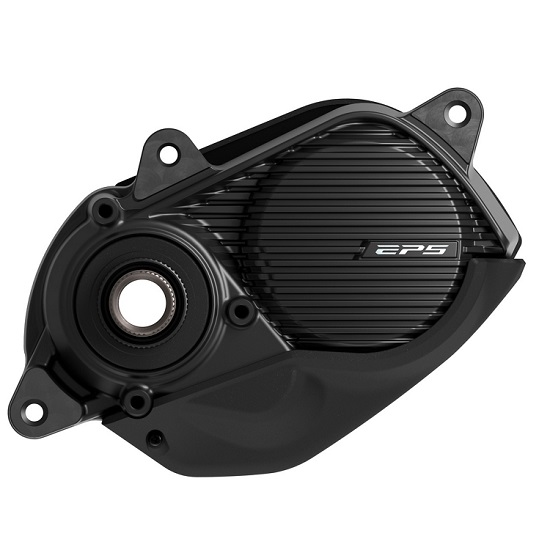
Shimano has unveiled two new mid-drive motors, the EP5 and E5100. The EP5 is capable of Class 3 performance while the E5100 is meant for Class 1 and 2 e-bikes.
The 36V EP5 motor produces 250W and 60Nm of torque—no word on max power output yet—and can be configured for use in Class 3 e-bikes with a top-assist speed of 28 mph. It reportedly weighs 3kg (6.6 lbs.).
The 36V E5100 motor produces 250W and a more modest 50Nm of torque. It is designed for use in Class 1 and Class 2 e-bikes with a maximum-assist speed of 20 mph. The motor reportedly weighs 2.4kg (5.3 lbs.).
The motors can be powered by one of three of Shimano’s internal batteries: 418Wh, 504Wh or 630Wh. On the low end, an e-bike with the EP5 motor may see a range of 23km (14.3 mi.) with the 418Wh battery (in Boost mode), while at the high end the 630Wh battery may power the EP5 for as much as 92km (57.2 mi.) (Eco mode).
The E5100 motor may cover as much as 57km (35.4 mi.) with the 41Wh battery (in Boost). With the 630Wh battery, Shimano estimates the E5100 motor may offer an impressive 260km (162 mi.) (Eco mode).
This is a recent price drop from Ride1Up’s ongoing summer sales event. Several models have been heavily discounted, but this might be the best deal currently.
It is surprising to see such a high sale price. Ride1Up is a brand that routinely maximizes buyer value, offering e-bikes that sell for a few hundred dollars less than what we would typically expect to see from many of its competitors.
In our original review of the Prodigy XC, we noted how well Ride1Up was able to thread the needle of making a bike that’s relatively lightweight, intuitive to ride, comfortable on the rider, and versatile enough to meet the needs of people exploring different places. All of that, plus $700 in savings, would be music to almost everybody’s ears.
Sponsor
Some links may be affiliate links. We may get paid if you buy something or take an action after clicking one of these.
A new bill in California is aimed at outlawing the unrestricted operation of e-bikes and bans the sale of devices that aid a rider in unlocking their e-bike.
California Assembly Bill 1774 amends Section 24016 of the Motor Vehicle Code with two new provisions aimed at curbing e-bikes that can exceed 28 mph.
In item (d) the bill states: “A person shall not tamper with or modify an electric bicycle […] so as to change the speed capability of the bicycle, unless the bicycle continues to meet the definition of an electric bicycle […] and the person appropriately replaces the label indicating the classification required[…].”
Item [e] adds: “A person shall not sell a product or device that can modify the speed capability of an electric bicycle such that it no longer meets the definition of an electric bicycle[…].”
Sponsor

Some links may be affiliate links. We may get paid if you buy something or take an action after clicking one of these.
TRP and Bosch have collaborated on an electronic drivetrain for both road and mountain that will shift automatically and be powered by Bosch’s battery.
TRP has collaborated with Bosch on a new electronic drivetrain for e-bikes equipped with Bosch motors. The TRP Bosch E.A.S.I. A12 uses a TRP-made electronic rear derailleur powered by the e-bike’s Bosch battery. But that’s just the beginning.
TRP is the high-end arm of Tektro; it stands for Tektro Racing Products. The TRP Bosch E.A.S.I. A12 is a 12-speed drivetrain. Though we’ve seen photos of integrated control levers for road and gravel e-bikes, TRP shows the drivetrain on an eMTB on their website. They show two cassettes; one features a 520 percent range (10-52t). The other features a slightly narrower 11-50t setup. Among the features that TRP touts on the site are automatic shifting so that you never have to think to shift. Riders can use Bosch’s Flow e-bike app to set their target cadence in case they choose automatic shifting. Manual shifting is, of course, an option, but so is a temporary manual override for riders who choose automatic shifting.
Perhaps the most intriguing feature of the drivetrain is the torque reduction it performs when shifting. The higher the torque the drivetrain is under when shifting, the more wear the drivetrain suffers. By reducing the amount of torque the motor produces while shifting, drivetrain longevity is increased. The shifting tends to be smoother and quieter as well.
The wireless shifter features a classic two trigger design. The shifter communicates via CMD technology and it runs on a CR-2032 watch battery.
Both Trikes From These E-Bike Heavyweights Have Their Merits. Which One is Best for You?
As two of our picks for the Best Electric Tricycles, the Rad Power Bikes RadTrike and the Lectric XP Trike are two options that consumers are likely to consider.
These models have much in common, and their similarities may make it difficult to sort out which is best for specific individual needs. By comparing the two trikes, we can more easily identify their differences.
Both brands took a unique approach in the areas of propulsion, frame design, brake systems, and user interface. There is certainly overlap between them, but as we will discuss, the two tricycles have individual, well-defined strengths and weaknesses.
With many similar features shared between the two models, which Trike earns our recommendation?
In addition to our standardized test data, there are SIX primary elements we consider when comparing the two trikes, as we detail below.
Some links may be affiliate links. We may get paid if you buy something or take an action after clicking one of these.
The USDOT has awarded a grant to the NYCDOT to create a lab that will research last-mile-delivery solutions, including the use of cargo e-bikes.
The U.S. Department of Transportation has given a $5.6 million grant to the New York City Department of Transportation from its Rebuilding American Infrastructure with Sustainability and Equity (RAISE) program. RAISE is part of President Biden’s Bipartisan Infrastructure Law, one of the largest infrastructure investments in U.S. history; to date it has awarded more than $1.8 billion in grants.
The RAISE money will fund the creation of an Urban Freight Mobility Collaborative (UFC). It is intended to serve as an innovation hub that will revolutionize urban freight movement while reducing greenhouse gas emissions. It will be the first lab of this sort in the United States.
The UFC will work with the community, industry and universities to create public-private partnerships that will explore ways to decarbonize freight movement. Their goal is to secure a 40 percent reduction in greenhouse gas emissions caused by freight movement by 2032.
A recent study demonstrated that delivery micro-hubs and cargo e-bikes could help save the city more than $240 million per year by simply eliminating delivery trucks idling while parked and blocking traffic.

Some links may be affiliate links. We may get paid if you buy something or take an action after clicking one of these.
A punchy motor defines the Trailblazer Pro’s ride experience with thrilling speeds and nearly effortless climbing.
If you are a larger rider needing an extra boost, or like Lightning McQueen, you tell yourself, “I am speed,” you’ll really dig what this bike can do.
HPC equipped the Trailblazer Pro with many nicer features that make for a great ride experience. Seasoned riders will love the precision of the suspension system with rebound and compression control. The tires’ grip, along with the lighter-weight design, helps it feel nimble through tight turns.
The handling was great despite our wishing for a slightly shorter chainstay length which would have made it feel a bit more agile. When it came time for the downhill though our handling complaints were all but gone, it was a lot of fun to hop around on.
The Trailblazer Pro turned many heads on our rides, either for its neon green accents or for how often we called out ahead to pass somebody. It’s a fun bike with a lot to unpack, so make sure to see how it did in our testing below.
